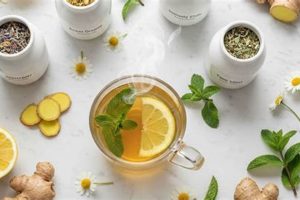
The temperature of the water used for infusion significantly impacts the resulting beverage’s flavor profile and therapeutic properties. Employing water that is too hot can scorch delicate herbs, leading to a bitter and unpleasant taste. Conversely, water that is not hot enough may fail to fully extract the essential oils and beneficial compounds present in the plant material. For example, green tea benefits from a lower water heat level than black tea.
Proper regulation is crucial for optimizing the extraction of desirable components, such as antioxidants and volatile oils, while minimizing the release of undesirable compounds, like tannins that contribute to bitterness. Historically, careful consideration of water heat levels has been integral to traditional herbal preparations, reflecting an understanding of its influence on the final product’s quality and efficacy.
Subsequent sections will delve into specific heat recommendations for various types of plants, the rationale behind these guidelines, and practical methods for achieving accurate and consistent results when preparing infusions.
Optimizing Infusion Through Precise Heat Management
Achieving optimal extraction and flavor in herbal infusions necessitates careful attention to heat. The following guidelines offer a framework for maximizing the potential of various plants used in creating soothing and healthful beverages.
Tip 1: Adhere to Recommended Ranges: Different herbs require distinct water heat. Delicate floral herbs and green teas typically benefit from temperatures between 170-185F (77-85C). Robust roots and barks may require temperatures closer to boiling, around 200-212F (93-100C).
Tip 2: Utilize a Thermometer: Relying on visual cues or estimations can lead to inconsistent results. Employ a reliable thermometer to ensure accurate measurement of the water’s heat, especially when dealing with sensitive botanicals.
Tip 3: Pre-Warm the Teapot or Mug: Before adding the heated water, pre-warm the receptacle with hot tap water. Discard the tap water and then proceed with the infusion. This prevents a significant drop in heat during the brewing process, promoting more consistent extraction.
Tip 4: Monitor Steep Time: While heat is crucial, steep time also plays a pivotal role. Over-steeping, even at the correct heat, can lead to bitterness. Consult specific guidelines for each herb to determine the appropriate duration.
Tip 5: Adjust for Altitude: At higher altitudes, water boils at a lower heat. Compensation is required to ensure adequate extraction. Consider increasing steep time slightly or using a covered vessel to retain heat.
Tip 6: Consider Water Quality: The mineral content of the water can influence the final taste. Filtered or spring water is generally preferred over tap water, as it minimizes unwanted flavors that may interfere with the herb’s natural profile.
Adhering to these principles ensures a more flavorful and therapeutically potent infusion. Careful consideration of both heat and technique enhances the overall experience.
The subsequent sections will explore the specific applications of these tips to various herbal categories, providing a practical guide for crafting the perfect beverage.
1. Extraction Efficiency

Extraction efficiency, in the context of herbal infusions, directly correlates with water heat levels. Higher water heat facilitates the more rapid and complete dissolution of soluble compounds from plant material. These compounds include essential oils, flavonoids, alkaloids, and other bioactive constituents responsible for the beverage’s flavor, aroma, and potential therapeutic effects. Insufficient heat will result in incomplete extraction, yielding a weak and potentially ineffective infusion. For example, preparing ginger tea with lukewarm water will fail to fully extract the gingerol, the compound responsible for its characteristic pungency and anti-inflammatory properties. The degree of extraction dictates the concentration of these compounds in the final product.
The relationship is not linear; exceeding optimal levels can degrade certain heat-sensitive compounds. Excessive heat may cause volatile oils to evaporate or delicate flavonoids to break down, resulting in a loss of desired flavor and medicinal qualities. Furthermore, excessively high heats can lead to the extraction of undesirable compounds, such as tannins, which contribute to a bitter and astringent taste. A practical example lies in the preparation of green tea; water that is too hot will extract an excess of tannins, overshadowing the tea’s more subtle, vegetal notes with a sharp bitterness. Consequently, optimal extraction necessitates a balance between maximizing the yield of beneficial compounds and minimizing the extraction of unwanted substances.
Understanding the interaction between water heat and extraction efficiency is crucial for achieving desired outcomes in herbal tea preparation. It requires careful consideration of the specific herb being used and adherence to recommended heat ranges. The application of this knowledge allows for the creation of infusions that are not only flavorful and enjoyable but also retain their intended therapeutic value. Challenges in optimizing extraction efficiency include accurately measuring water heat and accounting for variations in herb quality and processing methods. Ultimately, achieving maximum extraction is crucial for maximizing the benefits of herbal teas.
2. Flavor Modulation

Heat acts as a critical catalyst in shaping the flavor profile of herbal infusions. The application of specific water heat ranges influences the extraction of volatile oils, aromatic compounds, and other flavor-bearing constituents from plant materials. Different botanicals respond uniquely to heat levels, causing variations in the intensity and character of the resulting beverage. For instance, a lower heat is often favored for more delicate flavors to avoid scalding. Understanding this cause-and-effect relationship allows for targeted flavor modulation.
Precise water heat is of particular consequence when aiming to minimize undesirable flavor characteristics. Overly high heat can lead to the extraction of bitter compounds, such as tannins, while insufficient heat may fail to fully develop the desired aromatic notes. The interplay between water heat and steep time further modulates flavor; shorter steep times at slightly higher heat might achieve a similar flavor profile as longer steep times at a lower heat. Moreover, differences in water composition, particularly pH and mineral content, can further affect the final flavor. Utilizing filtered water, for instance, often results in a cleaner and more nuanced taste profile.
Effective flavor modulation through controlled water heat levels requires careful consideration of the specific herb, the desired flavor outcome, and potential confounding factors like water quality. Challenges arise in consistently replicating optimal heat conditions, especially when using manual methods. The practical significance of this lies in the ability to consistently produce high-quality herbal infusions with balanced and desirable flavor profiles, enhancing the overall sensory experience. The careful control of heat becomes a powerful tool for both amateur and professional herbalists.
3. Bioactive Preservation

The relationship between water heat and bioactive preservation in herbal infusions is critical to realizing the intended therapeutic benefits. Bioactive compounds, such as antioxidants, vitamins, and essential oils, are often heat-sensitive. Exceeding optimal heat ranges can lead to their degradation, diminishing the beverage’s potential health-promoting properties. Conversely, insufficient heat may result in inadequate extraction of these compounds, thereby limiting their bioavailability. The heat levels for different herbs may depend on various factors. For instance, the preservation of volatile oils in chamomile tea necessitates a lower heat range compared to the extraction of alkaloids from certain roots and barks. The effectiveness of herbal remedies is thus directly influenced by the appropriate heat during preparation.
The selection of appropriate water heat constitutes a crucial step in maximizing bioactive preservation. Lower temperatures, generally between 170-185F (77-85C), are recommended for delicate flowers and leaves rich in volatile oils, preventing their evaporation and maintaining their therapeutic integrity. Higher temperatures, approaching boiling point (200-212F or 93-100C), may be necessary for tougher plant parts like roots and barks to facilitate the release of less heat-sensitive compounds. However, even in these cases, prolonged exposure to excessive heat can still degrade certain bioactives. For example, overheating green tea can destroy catechins, key antioxidant compounds. Furthermore, the presence of antioxidants will degrade with exposure to heat and light.
Maintaining the stability of bioactive compounds in herbal infusions requires a nuanced approach to heat management. This necessitates accurate heat control, often achieved through the use of calibrated thermometers. Challenges include accounting for variations in herb quality and freshness, as well as adjusting for altitude, which affects water’s boiling point. Understanding the delicate balance between maximizing extraction and minimizing degradation is essential for harnessing the full therapeutic potential of herbal teas. Implementing proper heat control measures represents a practical strategy for ensuring that these beverages retain their intended health benefits.
4. Herb Specificity
The selection of the appropriate water heat during herbal tea preparation is critically dependent upon the specific herb being utilized. Each plant possesses a unique chemical composition, dictating its optimal extraction temperature and thus influencing the resulting beverage’s flavor, aroma, and therapeutic properties. The concept of “herb specificity” necessitates a nuanced understanding of these individual requirements to maximize the benefits of herbal infusions.
- Volatile Oil Content
Herbs rich in volatile oils, such as chamomile and lavender, require lower water heats, typically between 170-185F (77-85C). Exceeding this heat range risks the degradation and evaporation of these delicate aromatic compounds, diminishing the final beverage’s characteristic scent and therapeutic qualities. For instance, infusing chamomile at boiling temperatures can result in a bitter-tasting tea with reduced calming effects.
- Alkaloid-Bearing Herbs
Certain herbs, including those used in traditional Chinese medicine, contain alkaloids as their primary active compounds. These alkaloids often require higher water heats, approaching boiling point, for optimal extraction. However, even with alkaloid-bearing herbs, caution is warranted, as excessive heat can degrade other heat-sensitive compounds present within the plant material. Precise heat control is crucial to strike a balance between maximizing alkaloid extraction and preserving overall quality.
- Tannin Levels
Herbs with high tannin content, such as certain barks and roots, tend to release these compounds more readily at higher water heats. While tannins can contribute to a beverage’s astringency and antioxidant properties, excessive tannin extraction results in an unpleasantly bitter and drying taste. Therefore, carefully controlling the water heat is essential to manage tannin levels and create a palatable infusion. For example, over-steeping black tea at a high heat will release more tannins.
- Plant Part Used
The specific part of the plant being infused also influences the optimal water heat. Delicate flowers and leaves generally require lower temperatures compared to tougher roots and barks. Thicker plant parts necessitate higher heats to break down their cell walls and release their constituent compounds effectively. Understanding the structural differences between plant parts aids in tailoring the heat accordingly.
The principle of herb specificity underscores the importance of avoiding a one-size-fits-all approach to herbal tea preparation. By recognizing the unique thermal requirements of each plant, practitioners can optimize the extraction of beneficial compounds, minimize the release of undesirable substances, and consistently produce flavorful and therapeutically potent infusions. Deviation from heat-related guidelines increases potential for herbal tea failure.
5. Steep Time Correlation

The duration of infusion, or steep time, is intrinsically linked to the temperature of the water when preparing herbal beverages. This correlation dictates the extent to which soluble compounds are extracted from the plant material. Elevated water temperatures facilitate more rapid extraction, necessitating shorter steep times to prevent over-extraction and the release of undesirable components. Conversely, lower water temperatures require extended steep times to achieve adequate extraction of flavor and beneficial constituents. The interplay of these variables is crucial for achieving a balanced and palatable infusion. Incorrectly calibrated steep times can negatively affect flavor.
An illustrative example is the preparation of green tea. Employing boiling water combined with a prolonged steep time will invariably result in a bitter beverage due to the excessive extraction of tannins. In contrast, utilizing a lower water heat and a shorter steep time preserves the tea’s delicate flavor profile. Similarly, when infusing robust roots such as ginger, a longer steep time is generally required, but the upper limit must be carefully monitored to prevent the beverage from becoming overly pungent or bitter. Practical application of this understanding involves consulting specific guidelines for each herb, considering both the recommended water heat and steep time.
In summary, the relationship between steep time and water heat represents a fundamental principle in herbal tea preparation. Accurate calibration of these two variables is essential for optimizing flavor, aroma, and therapeutic properties. Challenges in achieving consistent results often stem from variations in herb quality and inaccurate measurement of steep time. A thorough understanding of this correlation enables practitioners to produce consistently high-quality infusions tailored to individual preferences and therapeutic needs, maximizing flavor, properties, and aromas.
6. Equipment Accuracy

The precision of equipment used in herbal tea preparation directly influences the accuracy and repeatability of achieving optimal water heat. Deviations from recommended water heats can compromise flavor profiles and therapeutic properties. Therefore, reliance on accurate measuring instruments is paramount in consistently producing high-quality herbal infusions.
- Thermometer Calibration
The accuracy of a thermometer used to measure water heat is fundamental. Thermometers should undergo regular calibration to ensure they provide reliable readings. Inaccurate thermometers can lead to significant temperature discrepancies, resulting in under- or over-extraction. For instance, a thermometer reading 10F (5.5C) lower than the actual water heat could cause under-extraction and a weak, flavorless infusion. Calibration methods include ice water and boiling water tests.
- Kettle Precision
Electric kettles with pre-set heat settings offer convenience but vary in accuracy. Some kettles may overshoot or undershoot the target temperature, impacting the final infusion. Evaluating a kettle’s precision using a separate, calibrated thermometer is advisable. Kettles that allow manual heat adjustments provide greater control over the heating process. Discrepancies in kettle heating lead to inconsistency and compromise control over herbal tea temperature.
- Measurement Consistency
Consistent measurement techniques are essential. Immersing the thermometer sensor fully into the water and avoiding contact with the kettle’s heating element ensure accurate readings. Variations in measurement technique can introduce errors, even with calibrated equipment. Standardizing the measurement process across different preparations enhances repeatability. Failing to use standardized equipment for measuring herbal tea temperature has severe inconsistencies.
- Environmental Factors
External environmental factors, such as ambient room heat, can influence equipment performance. Extreme ambient heat can affect thermometer readings or kettle heating cycles. Maintaining a stable environment during tea preparation minimizes potential errors. Awareness of environmental conditions is a necessary component of achieving precise water heat. These factors will degrade the quality of herbal tea and produce inconsistent herbal tea temperature.
The cumulative effect of equipment accuracy and consistent measurement techniques is a more reliable and reproducible process for achieving optimal water heat. By prioritizing precise instrumentation and standardized methods, practitioners can minimize variability and consistently create high-quality herbal infusions that fully realize their flavor and therapeutic potential.
Frequently Asked Questions
This section addresses common inquiries regarding the optimal water heat for preparing herbal infusions, providing clarification and guidance based on established principles.
Question 1: Why is water heat so crucial when preparing herbal teas?
Water heat significantly influences the extraction of soluble compounds from plant materials. Employing appropriate heat levels optimizes the release of beneficial substances while minimizing the extraction of undesirable components, such as tannins that contribute to bitterness.
Question 2: Does the optimal water heat vary depending on the herb?
Indeed, the ideal water heat varies considerably based on the specific plant. Delicate herbs with volatile oils generally benefit from lower heats, while tougher roots and barks may require higher heats for effective extraction.
Question 3: What happens if the water is too hot?
Excessive water heat can degrade heat-sensitive compounds, diminish flavor profiles, and promote the extraction of bitter substances. This results in a less palatable and potentially less therapeutic beverage.
Question 4: What happens if the water is not hot enough?
Insufficient water heat results in incomplete extraction of beneficial compounds, yielding a weak and potentially ineffective infusion. The full flavor and therapeutic potential of the herb remain unrealized.
Question 5: How can one accurately measure water heat?
Employing a calibrated thermometer is the most reliable method for accurately measuring water heat. Avoid relying solely on visual cues or estimations, as these can lead to significant temperature discrepancies. It is also important to consider if your thermometer will accurately and effectively measure herbal tea temperature.
Question 6: Does altitude affect the optimal water heat?
Yes, altitude affects the boiling point of water. At higher altitudes, water boils at a lower heat. Adjustments to steep time or the use of a covered vessel may be necessary to compensate for this effect and ensure adequate extraction.
Mastering water heat represents a cornerstone of effective herbal tea preparation, requiring careful consideration of plant-specific requirements and adherence to precise measurement techniques.
Subsequent sections will provide practical guidance on troubleshooting common issues and addressing challenges in heat management.
Conclusion
The preceding exploration of herbal tea temperature underscores its critical role in achieving optimal flavor, aroma, and therapeutic efficacy. Precise control over water heat is paramount, dictating the extraction of beneficial compounds and the avoidance of undesirable substances. Adherence to herb-specific heat guidelines, combined with accurate measurement techniques, is essential for consistently producing high-quality infusions.
The effective management of herbal tea temperature necessitates a commitment to precision and a thorough understanding of individual plant properties. Mastering these techniques enables practitioners to unlock the full potential of herbal infusions, maximizing both their sensory appeal and their inherent health benefits. Further research into the specific thermal requirements of individual herbs promises to refine and enhance the art of herbal tea preparation.