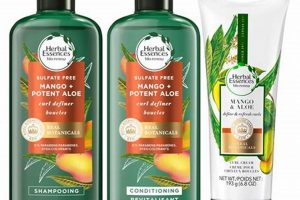
This product category encompasses formulations designed to ease the removal of knots and tangles from hair. These solutions typically incorporate ingredients that smooth the hair shaft, reducing friction and facilitating combability. As an example, such a product might be applied after shampooing to mitigate the difficulty often encountered when brushing wet hair.
The utilization of these products offers several advantages, including decreased hair breakage during styling and improved manageability. Historically, individuals have sought ways to detangle hair using natural oils and homemade concoctions. Modern formulations build upon this history, offering scientifically advanced blends that often include botanical extracts and conditioning agents to nourish the hair while detangling.
The subsequent sections will explore the specific ingredients commonly found in these formulations, examine the different types available, and discuss the optimal methods for application to achieve the best results. Consideration will also be given to factors such as hair type and environmental conditions that may influence product selection and efficacy.
Application Strategies for Enhanced Hair Detangling
The following guidelines are designed to maximize the efficacy of detangling products, promoting hair health and manageability.
Tip 1: Product Distribution: Ensure even application by dividing hair into sections. This prevents product buildup in specific areas and guarantees comprehensive coverage.
Tip 2: Application Technique: Employ a downward motion when applying the product. This aligns with the natural direction of the hair cuticle, minimizing friction and breakage.
Tip 3: Wet Hair Application: Apply the product to damp, not soaking wet, hair. Excess water dilutes the formula, reducing its detangling capabilities.
Tip 4: Comb Selection: Use a wide-tooth comb or a detangling brush. These tools are specifically designed to gently separate knots without excessive pulling or damage.
Tip 5: Starting Point: Begin detangling from the ends of the hair, gradually working upwards towards the roots. This prevents tangles from being pulled tighter and causing breakage.
Tip 6: Patience and Gentle Handling: Avoid forceful pulling or yanking. Apply gentle pressure and work through knots patiently to minimize damage.
Tip 7: Rinse Thoroughly (If Applicable): If the product is designed to be rinsed out, ensure complete removal to prevent residue buildup. Residue can weigh down the hair and attract dirt.
Consistent application of these techniques, coupled with the appropriate product, will result in healthier, more manageable, and less tangled hair.
The concluding section will summarize the key points discussed and provide recommendations for maintaining optimal hair health.
1. Botanical Ingredient Sourcing

The selection and procurement of botanical ingredients exert a direct influence on the quality and efficacy of the product. Specifically, the geographic origin, cultivation practices, and extraction methods employed to obtain herbal extracts contribute significantly to the final formulation’s performance. For instance, the concentration of active compounds in lavender oil, a common component of many detangling products, can vary substantially depending on whether the lavender is sourced from France, Bulgaria, or another region. Sustainable harvesting practices ensure long-term availability of these resources while mitigating environmental impact. A commitment to ethical sourcing also guarantees fair labor practices in the regions where these botanicals are cultivated.
The composition of the botanical extract also plays a pivotal role. Different extraction techniques, such as cold pressing, steam distillation, or solvent extraction, yield extracts with varying profiles of beneficial compounds. Consequently, manufacturers seeking to maximize the detangling and conditioning properties of their products must carefully evaluate the source and processing methods of their herbal ingredients. In the case of aloe vera, a frequently used moisturizing agent, the quality of the gel extract, which affects the level of polysaccharides and amino acids, will define the product’s hydration capacity. Suppliers who can consistently deliver high-quality, standardized extracts are thus highly valued.
In conclusion, the relationship between the source of botanical elements and product outcomes is critical. Product developers consider these factors to deliver effective formulations. Companies which prioritize sustainable and ethical sourcing, in addition to thorough quality control measures, are more likely to produce highly efficacious and consumer-trusted products.
2. Hair Fiber Alignment
Hair fiber alignment refers to the degree to which individual strands of hair lie parallel to one another. Disrupted alignment, characterized by raised cuticles and overlapping strands, increases friction, leading to tangles and knots. Products designed to detangle function, in part, by smoothing the hair cuticle and reducing this friction. Specifically, certain ingredients within these formulations, such as cationic surfactants and silicones, deposit on the hair shaft, effectively flattening the cuticle scales and promoting a more uniform surface. This smoothing action reduces inter-fiber friction, facilitating easier combing and brushing. For example, a hair strand treated with a detangling formulation exhibits less resistance when a comb is passed through it compared to an untreated strand.
The effectiveness of a detangler is directly correlated to its ability to improve hair fiber alignment. Polymers that create a lubricating film on the hair surface contribute significantly to this process. Moreover, maintaining proper hydration levels within the hair cortex is also crucial, as dry hair tends to be more porous and susceptible to tangling. Ingredients such as humectants and emollients work synergistically to retain moisture and enhance the smoothness of the hair. A practical application of this understanding is evident in the product selection process, where individuals with coarse or damaged hair often benefit from detanglers containing higher concentrations of conditioning agents, due to the increased cuticle disruption commonly associated with these hair types.
In summary, hair fiber alignment is a critical factor influencing the ease of detangling. Formulations designed to improve this alignment through cuticle smoothing and moisture retention contribute substantially to manageability and reduced breakage. The proper selection and application of these solutions can lead to enhanced hair health and improved aesthetic appearance. Challenges remain in developing formulations that offer long-lasting alignment without causing build-up or negatively impacting hair volume. Further research into bio-compatible polymers and advanced delivery systems may address these limitations.
3. Residue Minimization

Residue minimization is a crucial characteristic for detangling products, directly impacting hair health, manageability, and overall aesthetic appearance. Excessive residue from detangling agents can lead to product build-up, weighing down the hair, attracting dirt and pollutants, and potentially causing scalp irritation. Achieving effective detangling while minimizing residue is a primary objective in formulation development.
- Solvent Selection and Formulation Design
The choice of solvents and emulsifiers directly influences residue levels. Volatile solvents and lightweight emollients evaporate or are easily rinsed away, reducing build-up. Water-soluble polymers, as opposed to heavy silicones, contribute to easier product removal. Product formulations using micellar technology further minimize residue. For example, a detangling spray formulated with alcohol denat. as a carrier solvent will typically leave less residue than a cream-based product containing mineral oil.
- Concentration of Conditioning Agents
The concentration of conditioning agents, such as cationic surfactants or polymers, must be carefully calibrated. While these agents are essential for detangling and smoothing, excessive amounts can lead to residue accumulation. Manufacturers optimize formulations to strike a balance between detangling efficacy and residue minimization. For instance, a leave-in conditioner designed for fine hair will generally contain a lower concentration of conditioning agents compared to one intended for thick, coarse hair.
- Rinsing Instructions and Application Technique
Clear and precise rinsing instructions are essential for minimizing residue. Incomplete rinsing leaves product behind, contributing to build-up. Similarly, proper application techniques, such as even distribution and avoiding excessive product use, are critical. Detangling products that are specifically designed for leave-in application are formulated with residue minimization as a primary design consideration.
- Ingredient Quality and Purity
The quality and purity of ingredients play a role in residue potential. Impurities or byproducts present in raw materials can contribute to build-up. High-quality ingredients that are rigorously tested for purity help to minimize residue-related issues. Products incorporating plant-derived extracts can sometimes lead to residue due to waxes and other non-volatile components; careful selection of refined or processed extracts mitigates this.
Residue minimization is an essential aspect of detangling formulation. Manufacturers develop products that deliver detangling benefits without compromising hair health or aesthetic appearance. This balance requires thoughtful selection of ingredients, precise formulation design, and clear user instructions. Consumers can optimize their results by following application instructions, selecting products appropriate for their hair type, and ensuring thorough rinsing when applicable.
4. Tangle Prevention Efficacy
Tangle prevention efficacy, as a characteristic of detangling products, indicates the extent to which a formulation reduces the formation of knots and tangles after initial application. This effectiveness is not solely limited to the immediate detangling process but extends to the sustained manageability of hair over time. The formulation’s ability to deposit a protective layer on the hair shaft, reducing friction and static electricity, contributes directly to tangle prevention. For example, a detangler that effectively smooths the hair cuticle minimizes the likelihood of strands becoming entangled throughout the day due to environmental factors or normal movement.
In the context of “herbal essences detangler”, tangle prevention efficacy would be evaluated by assessing how well the product minimizes re-tangling after initial use. This assessment involves considering the specific ingredients and their mode of action. For instance, the inclusion of ingredients such as silicones, cationic polymers, or plant-derived oils within the formulation directly impacts its ability to reduce friction and static charge, thereby preventing tangles. Practical applications of this understanding include consumers selecting formulations that provide lasting detangling benefits based on their hair type and environmental conditions. Individuals with fine hair, prone to static, might benefit from a lightweight spray with antistatic agents, while those with thick, coarse hair may require a more emollient product to maintain smoothness and prevent tangles.
The practical significance of tangle prevention efficacy extends beyond mere convenience. By reducing the formation of knots and tangles, the product minimizes the need for aggressive combing or brushing, thereby decreasing the risk of hair breakage and damage. While achieving high tangle prevention efficacy is desirable, challenges exist in formulating products that offer lasting benefits without causing build-up or weighing down the hair. Innovative approaches, such as microencapsulation of active ingredients or the incorporation of bio-compatible polymers, may provide avenues for improved tangle prevention without compromising hair health. The connection between product formulation and real-world application underscores the importance of scientific rigor in the design and evaluation of detangling products.
5. Scalp Sensitivity Factors

Scalp sensitivity encompasses a range of conditions characterized by heightened reactivity to external stimuli. The selection of detangling products, including herbal essences detangler, necessitates careful consideration of potential irritants and allergens that can exacerbate underlying scalp conditions. A thorough understanding of common scalp sensitivity factors is crucial to minimizing adverse reactions and maintaining scalp health.
- Fragrance Components
Fragrances, both natural and synthetic, are frequent triggers of scalp irritation. Many individuals exhibit sensitivities to specific fragrance compounds, resulting in itching, redness, or even contact dermatitis. The inclusion of fragrance in herbal essences detangler requires evaluation for potential allergenic ingredients and consideration of fragrance-free alternatives for sensitive individuals.
- Preservatives
Preservatives, essential for preventing microbial growth in cosmetic formulations, can also elicit adverse reactions in sensitive scalps. Common preservatives, such as parabens, formaldehyde-releasing agents, and certain isothiazolinones, have been linked to allergic contact dermatitis. The formulation of herbal essences detangler should prioritize the use of milder, broad-spectrum preservatives that minimize the risk of scalp irritation.
- Botanical Extracts
While herbal essences detangler emphasizes the inclusion of botanical extracts, certain plant-derived ingredients possess inherent irritant or allergenic properties. Essential oils, for example, contain potent volatile compounds that can cause reactions in susceptible individuals. Furthermore, some botanical extracts may contain cross-reacting allergens, posing a risk to those with pre-existing sensitivities. Thorough testing and careful selection of hypoallergenic botanical extracts are necessary to mitigate these risks.
- pH Imbalance
The pH of the scalp and hair plays a critical role in maintaining its natural barrier function. Detangling products with a pH that deviates significantly from the scalp’s natural pH (typically around 4.5 to 5.5) can disrupt this barrier, leading to irritation and increased sensitivity. Herbal essences detangler should be formulated with a pH that aligns with the scalp’s natural acidity to minimize the risk of disruption and maintain overall scalp health.
Consideration of these scalp sensitivity factors is paramount in the design and selection of detangling products. Formulations should be meticulously evaluated for potential irritants and allergens, with a focus on minimizing the risk of adverse reactions and promoting long-term scalp health. A comprehensive approach, encompassing ingredient selection, formulation design, and thorough testing, is essential for creating detangling products suitable for individuals with sensitive scalps.
Frequently Asked Questions about Herbal Essences Detangler
The following addresses common inquiries regarding the use, composition, and efficacy of detangling products.
Question 1: What distinguishes a detangler from a leave-in conditioner?
A detangler is specifically formulated to ease the removal of knots and tangles by reducing friction between hair fibers. While some leave-in conditioners may offer detangling properties, their primary function is typically to provide hydration and nourishment. Detanglers often contain higher concentrations of slip agents, facilitating easier combing and brushing.
Question 2: Can this type of product be used on all hair types?
While most are designed for universal use, selecting a formulation appropriate for the specific hair type is recommended. Fine or oily hair may benefit from lightweight sprays, whereas thick, coarse, or dry hair may require richer creams or lotions. Misuse of product for a certain hair type might cause the product to weight the hair down.
Question 3: Is it necessary to rinse a product out after application?
The necessity of rinsing depends on the specific formulation. Some are designed to be rinsed out after detangling, while others are leave-in products intended to provide continued conditioning benefits. Always adhere to the instructions provided on the product label.
Question 4: Are there any potential side effects associated with frequent use?
Frequent use of certain formulations may lead to product build-up, potentially weighing down the hair or causing scalp irritation. Selecting products with minimal residue and incorporating clarifying shampoos into a hair care routine can help mitigate these effects.
Question 5: Can a detangler repair damaged hair?
While these products can improve the manageability and appearance of damaged hair, they do not possess reparative properties. Formulations containing proteins or amino acids may provide temporary strengthening benefits, but addressing the underlying causes of damage is essential for long-term hair health.
Question 6: How should a product be stored to maintain its efficacy?
To preserve the integrity and efficacy of a detangler, it should be stored in a cool, dry place away from direct sunlight and extreme temperatures. Proper storage helps prevent degradation of active ingredients and maintains product consistency.
In summary, understanding the nuances of these formulations allows for informed product selection and optimal utilization, contributing to improved hair health and manageability.
The subsequent section will provide a comprehensive comparison of available products, highlighting their key features and benefits.
Conclusion
The preceding analysis has examined the multifaceted nature of hair detangling formulations, emphasizing the significance of factors such as botanical ingredient sourcing, hair fiber alignment, residue minimization, tangle prevention efficacy, and scalp sensitivity considerations. These parameters collectively determine the suitability and effectiveness of a given product, influencing both immediate manageability and long-term hair health. A discerning approach to product selection, informed by an understanding of these key attributes, is essential for achieving optimal results.
The future of hair detangling technology lies in continued advancements in bio-compatible polymers, targeted delivery systems, and sustainable sourcing practices. Consumers are encouraged to prioritize formulations that demonstrate a commitment to both efficacy and ethical responsibility, contributing to a more sustainable and healthy approach to hair care. Further research into personalized formulations, tailored to individual hair types and scalp conditions, holds promise for maximizing the benefits of detangling products while minimizing potential adverse effects.