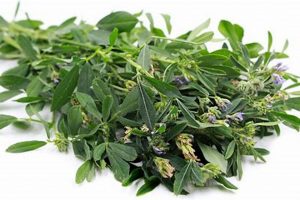
Natural treatments designed to control internal parasites in caprines are becoming increasingly popular. These remedies offer an alternative to conventional anthelmintics for livestock owners seeking a more holistic approach to animal health. Such preparations often utilize a variety of plants known for their antiparasitic properties, formulated to be administered orally to the animals.
The growing interest stems from concerns about anthelmintic resistance, a significant problem in goat farming worldwide. Reliance on traditional dewormers has led to parasites evolving resistance, rendering these drugs less effective. Natural alternatives offer a potential solution by introducing different modes of action, reducing the selective pressure for resistance. Furthermore, some producers are drawn to these solutions due to consumer demand for products from animals raised without synthetic drugs. Historically, many cultures have used various plants to address parasitic infections in both humans and animals.
The following discussion will delve into the specific herbs commonly used in these preparations, examining their purported mechanisms of action and the evidence supporting their efficacy. We will also explore the considerations necessary when implementing these alternative strategies, including proper dosing, administration techniques, and the importance of accurate parasite monitoring.
Application Strategies for Natural Deworming in Goats
Optimizing the effectiveness of natural antiparasitic protocols in goats requires a multifaceted approach. Careful planning and consistent execution are essential for successful implementation.
Tip 1: Accurate Identification of Parasites: Fecal egg counts are crucial to determine the specific parasites present and their load. This diagnostic step allows for targeted selection of appropriate herbal remedies, as different plants exhibit varying efficacy against different parasites.
Tip 2: Strategic Timing of Administration: Administering treatments during peak parasite transmission periods, often coinciding with warm, humid weather, can maximize impact. Regularly monitor fecal egg counts to assess treatment efficacy and adjust the regimen as needed.
Tip 3: Proper Dosage and Administration: Adherence to recommended dosage guidelines is paramount. Underdosing may lead to ineffective treatment, while overdosing could potentially cause adverse effects. Ensure consistent administration through palatable delivery methods to ensure adequate consumption.
Tip 4: Rotate Herbal Formulations: Just as with conventional anthelmintics, parasites can potentially develop resistance or tolerance to specific herbal compounds over time. Implement a rotation strategy, using different combinations of herbs periodically, to minimize the likelihood of resistance development.
Tip 5: Support Immune Function: A robust immune system is critical for goats to naturally combat parasitic infections. Provide a balanced diet rich in essential nutrients, including vitamins and minerals, to optimize immune function. Consider supplementing with immune-boosting herbs, such as echinacea, during periods of high parasite challenge.
Tip 6: Pasture Management Practices: Implement rotational grazing to break the parasite life cycle and reduce contamination of pastures. Maintain appropriate stocking densities to minimize stress and prevent overgrazing, which can weaken animals and increase susceptibility to parasites.
Tip 7: Observe and Record: Maintain detailed records of all treatments, fecal egg counts, and animal health observations. This data allows for tracking treatment efficacy over time and making informed decisions about future management strategies. Note any adverse reactions to herbal remedies and adjust protocols accordingly.
By employing these evidence-based strategies, goat producers can maximize the benefits of natural antiparasitic interventions and minimize the impact of internal parasites on animal health and productivity.
The concluding sections will explore specific herbal ingredients and potential areas for further research in this evolving field.
1. Anthelmintic Properties

The efficacy of any internal parasite control strategy hinges on its ability to disrupt the life cycle or physiological processes of the target parasites. This capacity, referred to as anthelmintic property, is the cornerstone of “herbal goat wormer” formulations. Without demonstrable anthelmintic activity, any substance, regardless of its natural origin, lacks the fundamental attribute required to control parasitic infections in goats. Certain plants contain compounds such as tannins, alkaloids, and sesquiterpene lactones, which have been shown to interfere with parasite feeding, reproduction, or neuromuscular function. The concentration and bioavailability of these compounds are crucial determinants of the plant’s overall anthelmintic effectiveness.
Real-world examples demonstrate the practical significance of understanding the specific anthelmintic properties of each herb. For instance, copper sulfate, a conventional anthelmintic, acts by disrupting the parasite’s enzyme systems. Similarly, some herbs, such as black walnut (Juglans nigra), contain juglone, a naphthoquinone with demonstrated anthelmintic activity against certain nematode species. However, the effectiveness of black walnut, and other herbs, may vary depending on the specific parasite species, the age and health status of the goat, and the method of preparation and administration of the herbal remedy. Therefore, the selection of herbs and the formulation of an effective “herbal goat wormer” requires a detailed understanding of each herb’s specific anthelmintic properties and their potential interactions.
In summary, the presence and strength of anthelmintic properties are the critical features determining the effectiveness of “herbal goat wormer” products. While natural remedies can offer a valuable alternative to conventional anthelmintics, a rigorous evaluation of the anthelmintic activity of each herbal component, along with careful consideration of factors such as dosage, administration, and parasite species, is crucial for successful implementation and to minimize the risk of treatment failure or adverse effects. Further research is needed to fully elucidate the specific mechanisms of action and to standardize the use of herbs for internal parasite control in goats.
2. Parasite resistance

Parasite resistance to conventional anthelmintics poses a significant threat to goat health and productivity. This phenomenon drives the investigation and adoption of alternative control strategies, including the use of “herbal goat wormer” formulations. The development of resistance necessitates a comprehensive understanding of its underlying mechanisms and the potential role of herbal remedies in mitigating its impact.
- Mechanism of Resistance Development
Resistance arises through the selection of parasite populations possessing genetic mutations that confer tolerance to specific anthelmintic drugs. Frequent and indiscriminate use of these drugs accelerates the selection process, leading to a rapid decline in their efficacy. This phenomenon is not unique to synthetic anthelmintics; it is theoretically possible for parasites to develop resistance to naturally occurring compounds as well.
- Impact on Goat Production
Anthelmintic resistance results in reduced weight gain, decreased milk production, and increased susceptibility to disease in goats. The economic consequences can be substantial, affecting both individual producers and the overall goat industry. The ineffectiveness of conventional treatments necessitates more frequent interventions and potentially higher doses, further exacerbating the resistance problem.
- Herbal Alternatives as a Resistance Management Tool
Some proponents of “herbal goat wormer” suggest that these formulations may offer a strategy to slow the development of anthelmintic resistance. By introducing different modes of action compared to conventional drugs, herbal remedies could potentially exert less selective pressure on parasite populations. However, rigorous scientific evidence supporting this claim is still limited, and the potential for resistance to herbal compounds should not be ignored.
- Importance of Integrated Parasite Management
Regardless of the anthelmintic strategy employed, an integrated approach is crucial for sustainable parasite control. This includes implementing sound pasture management practices, such as rotational grazing, to reduce parasite exposure. Strategic use of anthelmintics, informed by fecal egg counts and parasite identification, can minimize drug usage and slow the development of resistance. Integrating “herbal goat wormer” into this comprehensive plan requires careful monitoring and evaluation of its efficacy.
The emergence of parasite resistance underscores the need for a multifaceted approach to parasite control in goats. While “herbal goat wormer” may offer a potential tool in resistance management, it is not a panacea. Sound management practices, strategic anthelmintic use, and ongoing monitoring are essential for maintaining goat health and productivity in the face of increasing anthelmintic resistance.
3. Holistic approach

The term “holistic approach,” when applied to goat health, encompasses a management philosophy prioritizing the interconnectedness of various factors influencing an animal’s well-being. This perspective extends beyond merely addressing immediate symptoms; it emphasizes the creation of an environment that fosters natural resilience and resistance to disease. The selection and utilization of “herbal goat wormer” within a truly holistic framework necessitates a consideration of the animal’s diet, living conditions, stress levels, and immune system function. Treating parasite infection solely with herbal remedies without addressing these underlying contributors may yield limited or transient results.
For example, a goat raised on nutrient-deficient pasture will exhibit a compromised immune system, rendering it more susceptible to parasitic infection and less responsive to treatment, whether conventional or herbal. Similarly, overcrowding and poor sanitation create an environment conducive to parasite transmission, potentially negating the benefits of even the most potent “herbal goat wormer.” A holistic strategy would involve improving pasture quality through fertilization or rotational grazing, reducing stocking density to minimize stress and parasite load, and ensuring adequate access to clean water and mineral supplements. Only when these broader management aspects are addressed can the full potential of herbal interventions be realized. Some producers also incorporate supportive therapies, such as providing free-choice access to mineral licks containing diatomaceous earth, although scientific evidence supporting the efficacy of this practice is limited.
In conclusion, a “herbal goat wormer” should be viewed not as a singular solution but as one component of a comprehensive health management plan. The principles of a holistic approach dictate that addressing the root causes of parasitic infection, rather than simply treating the symptoms, is essential for long-term success. This requires a commitment to providing optimal nutrition, minimizing stress, maintaining a clean and sanitary environment, and carefully monitoring parasite levels. Integrating “herbal goat wormer” into this broader context enhances its effectiveness and promotes the overall well-being of the goat herd.
4. Herbal efficacy

The concept of “herbal efficacy” is intrinsically linked to the value of “herbal goat wormer.” Without demonstrable efficacy, a preparation marketed as an anthelmintic is functionally inert. The term efficacy, in this context, denotes the capacity of the herbal formulation to reduce or eliminate internal parasite burdens in goats under field conditions. This capacity is often quantified through fecal egg counts conducted before and after treatment, providing a measurable indicator of the herbal intervention’s impact. Demonstrating efficacy requires rigorous scientific methodology, including controlled trials with appropriate sample sizes and statistical analysis to differentiate between treatment effects and random variation. Real-world examples underscore the importance of this validation process. A study evaluating a commercially available “herbal goat wormer” revealed no significant reduction in fecal egg counts compared to a control group, highlighting the critical need for empirical evidence before adopting such interventions.
Further analysis reveals the complexities inherent in assessing herbal efficacy. The composition of “herbal goat wormer” formulations can vary significantly, with different herbs possessing varying concentrations of active compounds. Furthermore, factors such as the age and health status of the goat, the specific parasite species present, and environmental conditions can influence the response to treatment. A formulation effective against Haemonchus contortus, a common blood-sucking parasite, may exhibit limited efficacy against other nematode species. Therefore, a comprehensive understanding of the herbal composition, target parasites, and host factors is crucial for predicting and interpreting the outcome of treatment. The practical application of this understanding involves tailoring the herbal formulation to the specific needs of the goat herd, taking into account the prevalent parasite species and the overall health status of the animals.
In conclusion, herbal efficacy represents the cornerstone of “herbal goat wormer.” Rigorous scientific evaluation is essential to validate the anthelmintic properties of these formulations and to determine their effectiveness under real-world conditions. Challenges remain in standardizing herbal preparations and accounting for the numerous factors influencing treatment outcomes. However, a commitment to evidence-based practices and a thorough understanding of herbal composition, target parasites, and host factors are crucial for maximizing the potential benefits of “herbal goat wormer” and ensuring the health and productivity of goat herds.
5. Dosage precision

The effectiveness and safety of any anthelmintic treatment, including “herbal goat wormer,” are inextricably linked to dosage precision. Underdosing can result in treatment failure, allowing parasites to survive and reproduce, potentially contributing to anthelmintic resistance. Conversely, overdosing may lead to toxicity in the treated animal. Herbal formulations, despite their natural origin, contain bioactive compounds that can exert detrimental effects if administered improperly. The narrow therapeutic window for some herbal remedies necessitates careful attention to dosage recommendations. The composition of herbal mixtures also varies, influencing the concentration of active ingredients and requiring adjustments in dosage to achieve the desired effect.
Examples illustrate the practical implications of this principle. Consider a scenario where a goat producer uses a “herbal goat wormer” containing garlic as a primary active ingredient. Garlic contains allicin, an organosulfur compound with documented anthelmintic properties. However, allicin’s concentration varies depending on the garlic variety, growing conditions, and processing methods. Therefore, a blanket dosage recommendation may be inappropriate, potentially leading to underdosing with a less potent garlic batch or overdosing with a more concentrated one. Accurate body weight assessment is also crucial, as dosage is typically calculated based on the animal’s weight. Visual estimation of weight can be inaccurate, especially in diverse goat breeds, leading to significant errors in dosage administration.
In conclusion, dosage precision is paramount for maximizing the benefits and minimizing the risks associated with “herbal goat wormer.” Producers must adhere to recommended dosage guidelines, accounting for variations in herbal composition, animal body weight, and overall health status. Further research is needed to standardize herbal formulations and develop more precise dosing recommendations. Until then, a cautious and informed approach, guided by veterinary consultation and careful observation of the treated animals, is essential for safe and effective use of “herbal goat wormer.”
Frequently Asked Questions About Herbal Goat Wormer
This section addresses common inquiries concerning the use of herbal preparations for internal parasite control in goats. The information provided aims to clarify prevalent misconceptions and offer guidance based on current knowledge.
Question 1: Are herbal goat wormers as effective as conventional dewormers?
The efficacy of herbal goat wormers can vary significantly depending on the specific formulation, target parasite, and individual animal factors. While some studies suggest potential benefits, more research is needed to establish consistent efficacy comparable to that of conventional anthelmintics. Reliance solely on herbal treatments without monitoring parasite loads may lead to inadequate control.
Question 2: Are herbal goat wormers safe for all goats, including pregnant and lactating does?
The safety of herbal goat wormers for pregnant and lactating does requires careful consideration. Certain herbs may possess abortifacient or teratogenic properties. It is essential to consult with a veterinarian experienced in herbal medicine to determine the suitability of a particular formulation for vulnerable populations of goats.
Question 3: Can herbal goat wormers be used to prevent parasite resistance?
While the use of herbal goat wormers may potentially slow the development of anthelmintic resistance by introducing different modes of action, parasites can still develop resistance to herbal compounds over time. Strategic rotation of deworming agents, including both conventional and herbal options, along with sound pasture management practices, is crucial for resistance management.
Question 4: How should herbal goat wormers be administered?
Proper administration is critical for achieving optimal results with herbal goat wormers. Dosage should be calculated accurately based on the animal’s weight and the concentration of active ingredients in the formulation. Palatability can be a challenge, so administering the remedy through a drench, feed additive, or bolus may be necessary.
Question 5: What are the potential side effects of herbal goat wormers?
Although generally considered safer than synthetic drugs, herbal goat wormers can still cause adverse effects in some animals. Potential side effects may include digestive upset, allergic reactions, or, in rare cases, toxicity. Close monitoring of treated animals is essential, and any adverse reactions should be reported to a veterinarian.
Question 6: Where can reliable information about herbal goat wormers be found?
Consultation with a veterinarian experienced in herbal medicine is the most reliable source of information. Reputable universities and agricultural extension services may also offer resources on herbal parasite control in livestock. Exercise caution when relying on anecdotal evidence or unsubstantiated claims from commercial sources.
Effective parasite control in goats demands a comprehensive strategy that integrates responsible deworming practices, careful monitoring, and sound management practices. While herbal goat wormers may play a role in this strategy, it is essential to approach their use with informed awareness and a commitment to evidence-based decision-making.
The following section will delve into potential areas for further research and development related to herbal parasite control in goats.
Conclusion
The exploration of “herbal goat wormer” reveals a complex landscape of potential benefits and limitations. These natural preparations offer an alternative avenue for managing internal parasites in goats, particularly as concerns regarding anthelmintic resistance escalate. However, the effectiveness of “herbal goat wormer” depends heavily on factors such as accurate parasite identification, appropriate dosage, strategic timing of administration, and the overall health and management of the goat herd. The presence and concentration of anthelmintic compounds within the chosen herbs are critical determinants of success, underscoring the importance of sourcing high-quality ingredients and understanding their specific mechanisms of action.
The future of parasite control in goats likely involves an integrated approach, combining conventional and alternative strategies. Continued research is essential to fully elucidate the efficacy, safety, and optimal use of “herbal goat wormer.” A commitment to evidence-based practices and a thorough understanding of both the parasite and the host are necessary to ensure the health and productivity of goat herds while minimizing the development of anthelmintic resistance. Responsible application and rigorous evaluation remain paramount for the successful integration of herbal remedies into sustainable parasite management programs.